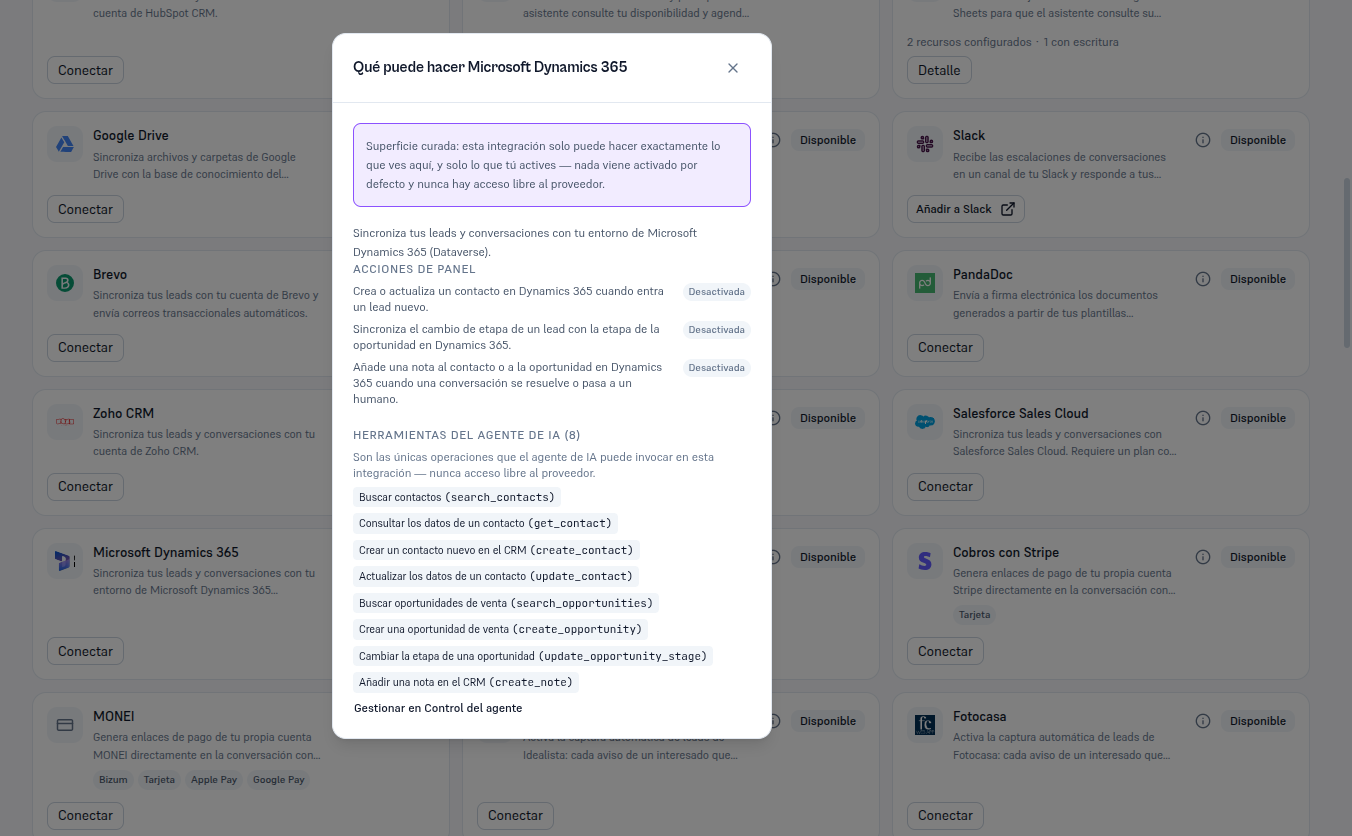
Connecting Dynamics 365 doesn’t activate anything on its own: both panel actions and agent tools are born off — the same “nothing on by default” principle that governs the rest of your agents’ resources.
From the Microsoft Dynamics 365 card, already Connected, click Detail to open its record. You’ll see four tabs — Resources (Dynamics has no additional resources to configure here, so this tab stays empty), Agent, Connections (the “principal” connection, the only one for this integration) and Status (section 6).
On the Agent tab you’ll find two independent lists:
| Panel action | What it does |
|---|---|
| Lead → contact | Creates or updates a contact in Dynamics 365 every time a new lead comes into your Platform. |
| Stage → opportunity | Syncs a lead’s stage change with the corresponding opportunity’s stage in Dynamics 365. |
| Conversation note | Adds a note to the contact or the opportunity in Dynamics 365 when a conversation is resolved or handed off to a human — with a bounded excerpt of the latest messages, never the full conversation. |
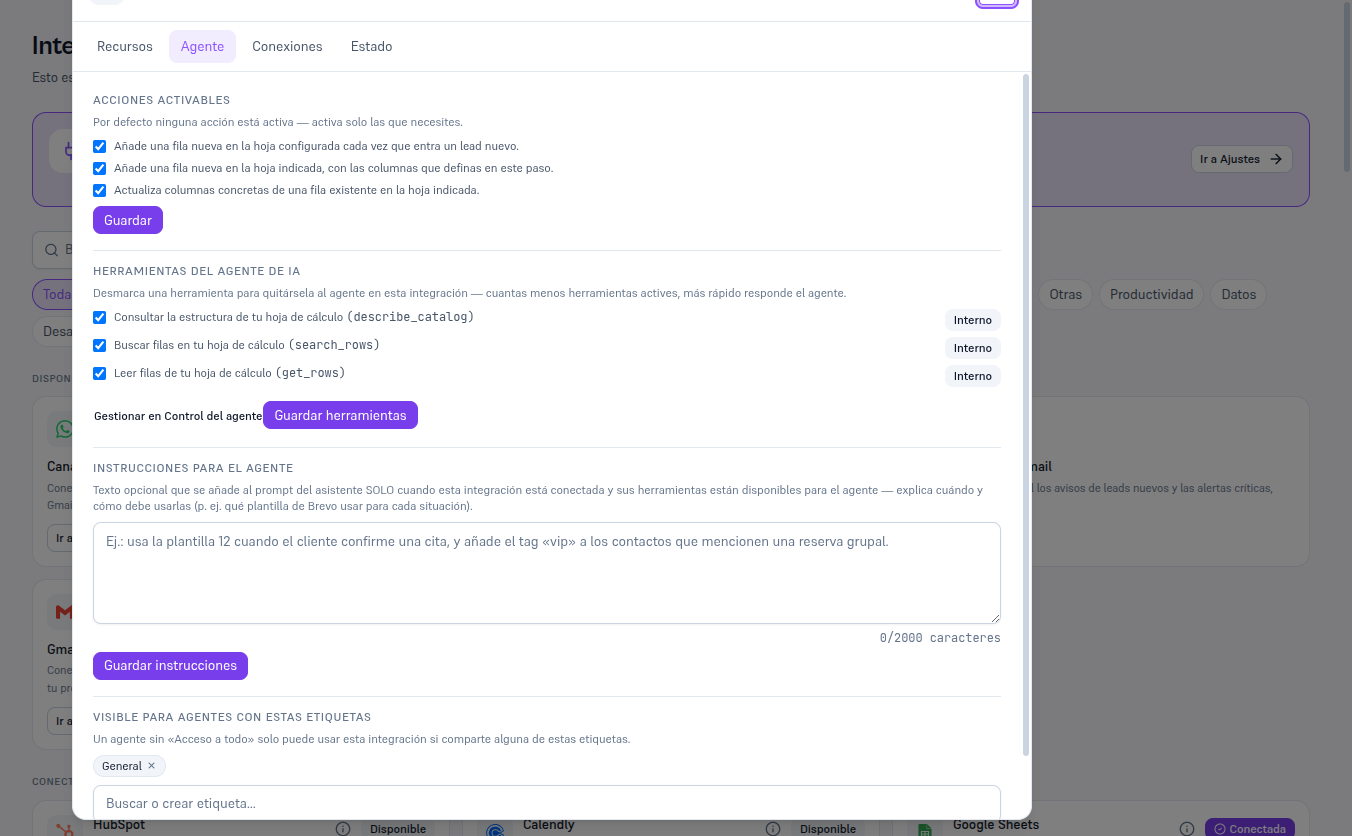
And the list of AI agent tools, with the eight operations the agent can invoke (section 7) — each with a button to uncheck it if you don’t want the agent to use it, and a “Manage in Agent control” link that leads to the screen where it’s decided, per tool, whether it’s Internal (only your team uses it from chat) or Both (your end customers also use it) — Manual 52 · Agent control and permissions covers that screen in detail. By default, “Create a new CRM contact” and “Add a CRM note” are Both; the other six (searches, updating a contact, everything about opportunities) are Internal — the agent uses them, but doesn’t tell the customer about it or wait for their confirmation. It’s the same split already used by HubSpot and Zoho CRM (Manuals 63 and 70): the three integrations share a mold.
The “What can Microsoft Dynamics 365 do” button (the i icon) on the card itself shows this same summary — panel actions and agent tools, with their activated/deactivated status — without needing to connect yet: it’s a way to see beforehand, before pasting any credential, exactly what this integration would do.
Once connected, the Agent tab of the detail shows the same lists, now with checkboxes to activate/deactivate and a Save button for each. The example below uses Google Sheets (already connected in this test tenant) to show what that tab really looks like once there’s a connection — with Dynamics 365 connected you’ll see the same layout, with Dynamics’s own actions and tools described above.